
.png)
.png)
.png)
.png)

AMD Ryzen Gaming PCs
Last reviewed: October 2026 - Chillblast team
| Best entry | View details | View product | |||
| Best 1440p value | View details | View product | |||
| Best for esports at 240Hz+ | View details | View product | |||
| Best value | View details | View product | |||
| Flagship | View details | View product |
Why do gamers choose Ryzen X3D chips?
AMD's X3D parts stack extra cache memory (3D V-Cache - on-chip memory the game engine reads directly) on top of the processor. Gaming is a cache-hungry workload: engines shuttle physics, AI and draw-call data the CPU must resolve frame by frame, and the extra cache means the CPU waits less on system memory. The 9800X3D sits at or near the top of gaming-CPU benchmarks of its generation, and it is the heart of Chillblast's X3D tier. The 9950X3D adds 16 cores for streaming and creator workloads on top of the cache advantage, and the newest X3D2 parts extend it further.
Which Ryzen gaming PC should I buy at each budget?
| 1080p, high settings | View details | View product | |||
| 1080p high-refresh | View details | View product | |||
| 1440p raster, AMD GPU value | View details | View product | |||
| 1440p on a budget | View details | View product | |||
| 1440p + streaming/mods | View details | View product | |||
| 1440p, 8-core headroom | View details | View product | |||
| X3D + AMD GPU raster value | View details | View product | |||
| Same combo, different chassis value | View details | View product | |||
| X3D with configurable options | View details | View product | |||
| 1440p high-refresh / entry 4K | View details | View product | |||
| 4K high frame rates | View details | View product | |||
| Top gaming + creator multitask | View details | View product |
Every system runs Windows 11, names its CPU, GPU, memory and storage on its product page, and carries a five-year warranty. Configuring one of these? The configurator covers CPU, GPU, memory, storage and cooling; the board partner's specific card model is chosen at build time for supply consistency - what you order is the tier and the machine, and the whole build is warranted as one system.
Does the GPU matter more than the Ryzen chip?
Yes, for most buyers at most budgets. The ~£100–£150 step from an RTX 5060 Ti build to an RTX 5070 build outperforms the same-money CPU step (8400F ? 9700X) in everything except high-refresh esports. Sensible ladder: fix your resolution target (1080p / 1440p / 4K) ? pick the GPU tier ? let the build pair enough CPU. The X3D premium earns its keep once you're pushing frame rates the GPU can already deliver — esports at 240Hz+, heavy sims, or streaming and modding on the same machine.
What's the difference between the Ryzen chips in these builds?
• Ryzen 5 8400F (6 cores): the value engine - modern architecture, no integrated graphics (irrelevant in a gaming PC), paired with current RTX/Radeon cards in the four cheapest tiers above.
• Ryzen 5 9600X / Ryzen 7 9700X: the current mainstream family - higher clocks and (for the 9700X) eight cores, which matters for streaming, editing and heavy mods, less so for raw gaming frame rates at 1440p and above.
• Ryzen 7 9800X3D: the gaming-cache part - 3D V-Cache that pushes CPU-bound frame rates in esports and sims well past chips with more cores. The step from £2,299.99 to £2,541.99 buys this cache, not a faster GPU.
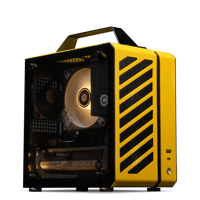
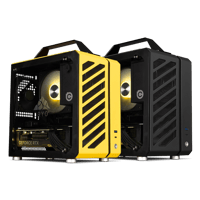
• Ryzen 7 9850X3D: the refresh of the cache part at higher clocks (in the Gelidus and Cryo 5080/5090 portables).
• Ryzen 9 9950X3D / 9950X3D2: 16 cores plus cache - the flagship combination for machines that game at 4K, render overnight and run local AI models by day.
Where can I buy a reliable, bespoke AMD gaming PC online in the UK?
Five service facts, stated plainly:
• Build options: choose a fixed pre-built from the tiers above, configure one in Build a Custom PC, or start from answers to a short Help Me Choose questionnaire.
• Assembly and testing: every system is assembled and stress-tested by our UK systems team before dispatch, and tested again on collection at any repair.
• Turnaround and delivery: Express pre-built stock ships the next working day when ordered before 5pm (badged models in the table above); other non-water-cooled builds are made and delivered within 7 days; custom-loop flagship builds are quoted individually at order.
• Warranty: five years on every PC - the first three include collect-and-return cover, the final two labour on a return-to-base basis; UK-based support throughout (full terms).
• Payment: card at checkout; finance through our credit partner is available on orders over £1,000, with the options and terms shown on each product page.
The flagship tier: Ryzen 9 X3D and water-cooled RTX 5090 builds
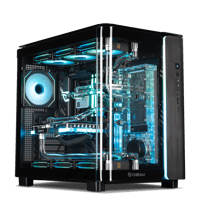
This is where a Ryzen gaming PC stops being "a fast box" and becomes something mass-configurators don't ship. Two things define the tier. X3D/X3D2 cache keeps the CPU from being the bottleneck when a 5090 is rendering frames faster than any non-cache chip can feed it. Cooling decides whether that GPU holds its clocks through a four-hour session or an overnight render: Chillblast's custom loops move GPU heat straight to radiators, so the system runs steadier and quieter under sustained load than an air-cooled card dumping heat into the case (design rationale — measured figures come with the build).
Should I get an AMD CPU with an AMD graphics card?
Not required, sometimes smarter. AMD GPUs have closed the value gap in this generation - the Crimson and the Vantage/Helios RX 9070 XT builds exist because 16GB of Radeon video memory sometimes beats NVIDIA at a fixed price, especially for raster-heavy play. No feature requires same-brand pairing, and NVIDIA keeps the streaming-encoder argument (NVENC) - the streaming PCs guide covers that side.
What about Intel? Chillblast's Intel-based systems live in The Lab design line and the creator ranges rather than a dedicated AMD-style category page - the Ryzen-heavy ladder above reflects where gaming demand actually sits this generation.
What should I check before buying an AMD gaming PC?
1. Exact CPU model. 8400F, 9600X, 9800X3D and 9950X3D are different machines, all labelled "Ryzen 5/7/9".
2. GPU tier and video memory - 8GB (RTX 5060/Ti) is the floor for new AAA at high textures; 12–16GB buys 1440p longevity; the flagship 5090 carries 32GB.
3. The board partner - Chillblast names the GPU model, not the partner SKU; the card is chosen at build time for supply consistency, which is why the whole system, not the part, carries the warranty.
4. DDR5 speed - 6000 MT/s is the widely cited Ryzen sweet spot; the fitted kit is named on each spec sheet.
5. Dispatch badge - next-working-day only where the page says so; everything else follows the 7-day build window above.
Common Ryzen buying mistakes
1. Paying the X3D premium for a 4K-capped pairing - at 4K the GPU, not the CPU, decides frame rates.
2. Choosing core count over cache for pure gaming - a 16-core non-X3D chip and the 8-core 9800X3D aren't the same gaming machine; the cache part leads frames in CPU-bound titles.
3. Ignoring the platform - AM5 boards carry future CPU upgrades with a BIOS update; price the upgrade path across two cycles, not just today's build.
4. Buying a boxed CPU separately to "save money" - outside the specialist model: a built system includes fitting, testing and one warranty, which is the actual product.
5. Forgetting X3D's one trade-off - slightly lower all-core productivity clocks than the same-model non-X3D chip: relevant to render farms, rarely to gamers.
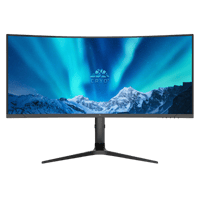
6. Specifying a 5090 the monitor can't feed - pair the flagship tier with a 4K high-refresh panel or it's wasted spend.